A campaign that worked for six weeks starts costing more for the same result. Nothing changed in the account. The instinct is to blame the auction, and the auction is almost always innocent.
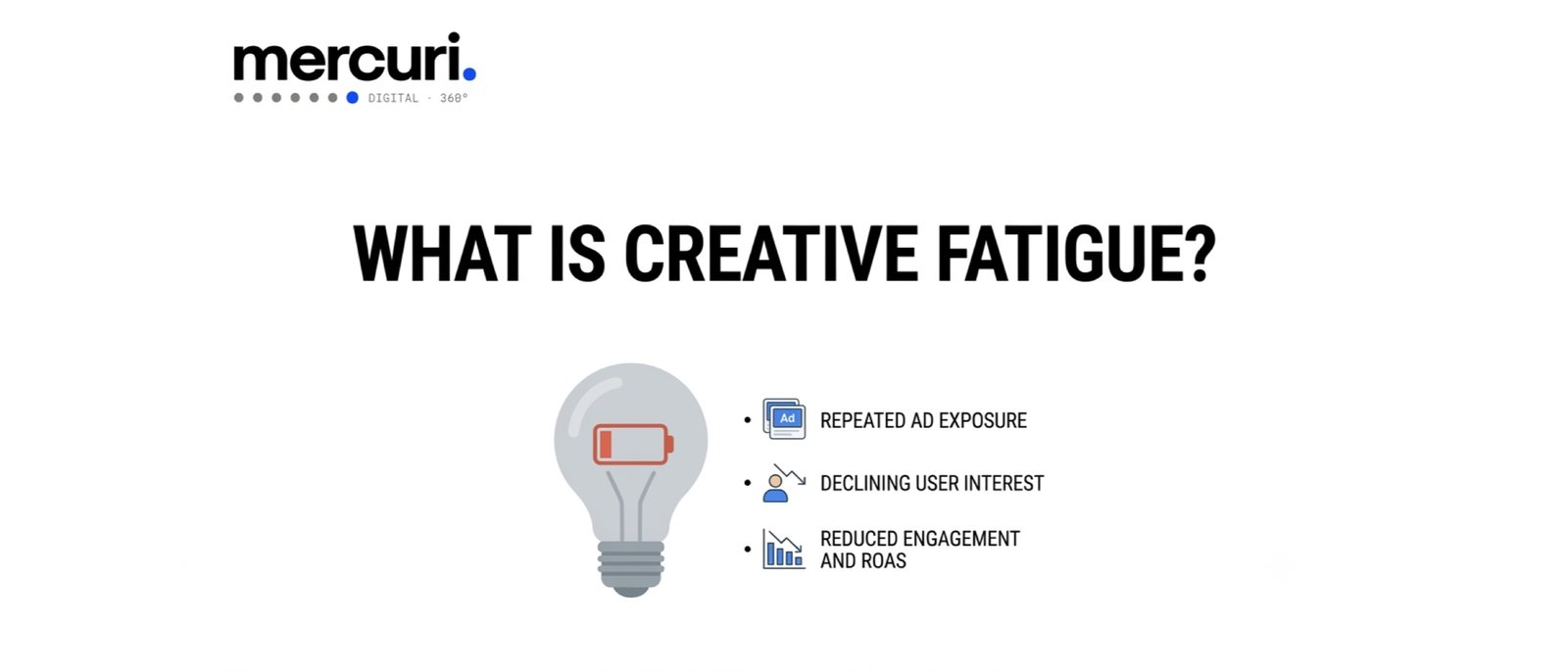
Creative fatigue is an attention problem wearing an efficiency problem as a disguise. The same people have seen the same idea enough times that it has stopped registering, and every metric downstream reports that as a cost increase.
What is actually happening
Three things compound. Frequency rises inside a finite audience. The novelty that earned attention in the first place decays with each exposure. And the delivery system reallocates budget toward whatever still performs, which narrows the audience further and makes frequency climb faster still.
That last part is why fatigue accelerates rather than declining gently. The system is doing exactly what you asked, and the result is that a shrinking pool of people see the ad more often, which is the precise condition fatigue needs.
- Week 1100
- Week 284
- Week 367
- Week 452
Telling fatigue apart from everything else
This is where most of the money is lost, because several very different problems produce the same headline symptom. Cost went up. Diagnosing which one you have is worth more than any refresh.
The order in which metrics move is the most reliable tell. Genuine fatigue shows up first in click rate, then in conversion rate, with cost rising last as a consequence of both. When that sequence is inverted or absent, the problem is something else.
- Fatigue — click rate falls while frequency climbs on a stable audience, and new creative recovers it.
- Seasonality — the whole account moves together, including organic and direct traffic.
- Competitor entry — cost per thousand rises while click rate holds; you are paying more for the same attention.
- Landing page or tracking break — click rate is steady and conversion falls off a cliff. Check the page before touching a single ad.
- Audience exhaustion — frequency climbs and no creative fixes it, because the pool is too small rather than the idea too old.
That final distinction is the expensive one. Refreshing creative against an exhausted audience burns production budget on what is actually a targeting problem, and it fails twice: once when the new ads underperform, and again when the team concludes the creative team is the issue.
What actually counts as new
Most refreshes fail because they happen at the wrong level. Teams change the colour grade, swap the opening shot, recut the same footage, and are surprised when performance does not recover. Fatigue attaches to the idea, not to the file.
There is a hierarchy, and only the top of it genuinely resets the clock. A new angle gives the viewer a different reason to care. A new hook opens the same argument differently. A new format re-presents it. A new variant changes almost nothing beyond the file name.
- 01Angle
- 02Hook
- 03Format
- 04Variant
A practical consequence: a library of thirty executions of one idea will fatigue roughly as fast as one execution. What extends a campaign is a stock of distinct angles, not a stock of assets.
Fatigue arrives at different speeds
How fast an idea burns out is mostly a function of how many people can see it. Retargeting audiences are the smallest pool in the account, so they fatigue first and hardest — often within days at meaningful spend. Broad prospecting has far more room and can carry a strong concept for weeks.
This is why a single refresh cadence across the whole account is the wrong instrument. Retargeting needs new work constantly and tolerates simpler production. Prospecting needs fewer, better ideas and rewards the effort put into them. Running one schedule for both means overproducing for one and starving the other.
Spend level matters as much as audience size. Doubling budget against the same pool does not double reach; it mostly doubles frequency, which means the same concept will exhaust itself in roughly half the time. Any scaling plan that does not come with a matching creative plan is scheduling its own decline.
The first week of decay
When numbers start slipping, the order of investigation saves more money than the eventual fix. Work downstream to upstream, because the cheapest explanations sit closest to the money.
- Confirm tracking and the landing page still work — this costs ten minutes and explains a surprising share of sudden drops.
- Check frequency and audience size, which separates a tired idea from an exhausted pool.
- Compare cost per thousand against the previous period to rule out auction pressure you cannot control.
- Only then look at the creative, and look at the angle before the execution.
Resist the urge to change several things at once while performance is falling. A panic refresh that also adjusts budget, audience and bidding leaves nobody able to say what recovered it, which guarantees the same scramble next quarter.
Make fatigue routine instead of urgent
Fatigue is predictable, which means it can be scheduled. The teams that never appear to suffer from it are rarely making better ads; they are making more ideas and retiring old ones on a calendar rather than in a panic.
- A production cadence sized to spend — higher budgets exhaust an idea faster and need more concepts, not more variants.
- A retirement rule agreed in advance, so nobody has to defend killing an ad that is still technically profitable.
- One variable per test, so a result can actually be read and reused.
- A running list of angles, which is the asset that compounds. Executions are consumable; reasons to care are not.
Fatigue is not a failure of the ad. It is the predictable end of its useful life.
Treated as an emergency, fatigue produces rushed creative that fatigues faster. Treated as a schedule, it becomes the least dramatic line in the plan — a known cost of running attention-based media, budgeted for like any other.