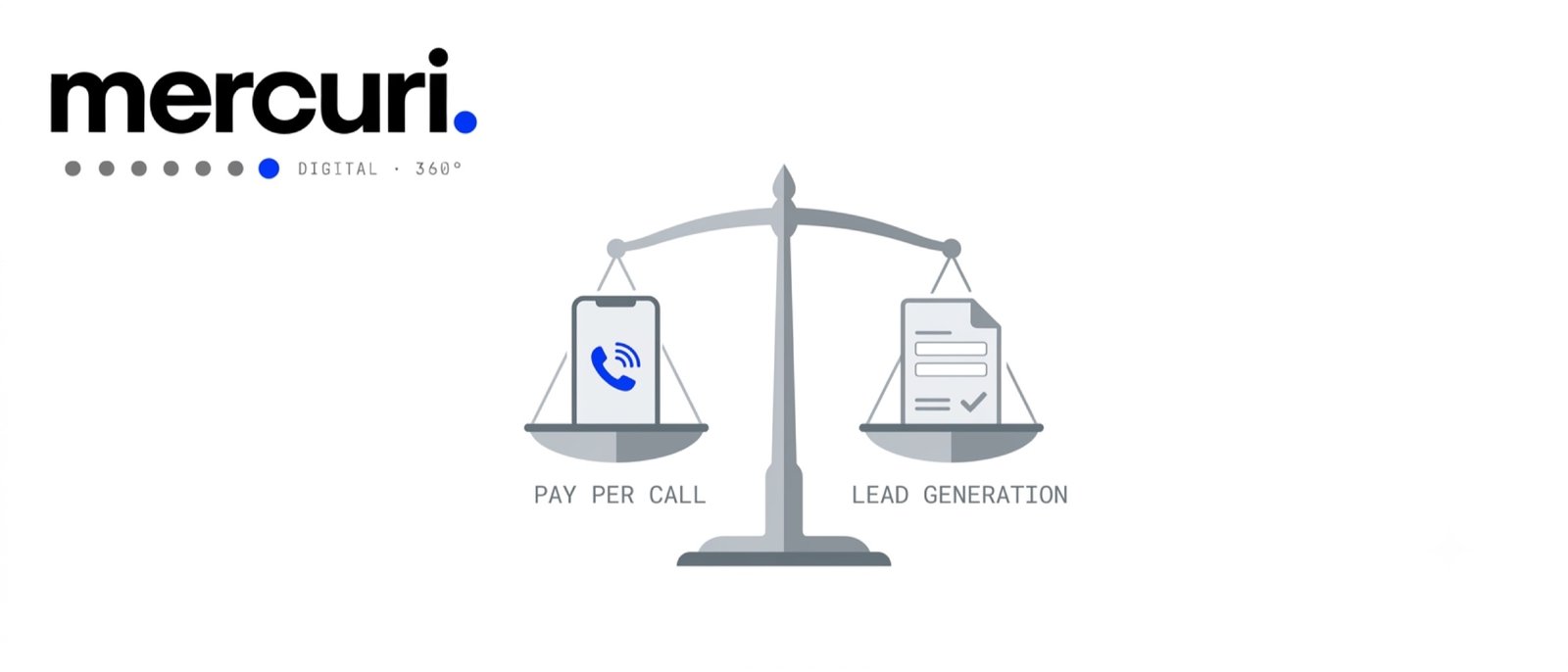
Both models sell the same thing: a person who is already looking. They differ in what they hand you at the moment of purchase — a conversation already in progress, or a record you still have to work.
That difference looks small on a rate card. Downstream it changes almost everything: who carries the qualification burden, how fast the outcome lands, what you can prove after the fact, and where margin quietly leaks.
How each model actually works
In pay per call, a publisher or paid placement drives a consumer to a tracking number rather than a landing page. The call is routed in real time against whatever rules the buyer sets — state, licence, capacity, hours, concurrency. The buyer pays once the call clears a billable threshold, usually a duration floor and sometimes a disposition code.
- 01Click
- 02Tracking number
- 03Routing
- 04Live agent
- 05Billable
Lead generation takes the same demand and puts it in a different container. The consumer completes a form. The record is validated, deduplicated against existing files, and delivered into a CRM. The buyer pays on delivery and then owns everything that follows — the dial, the voicemail, the second attempt, the eventual contact.
Intent is not equal at the point of sale
A call is self-selecting. Someone who dials has decided to speak to a person now, and they are on the line while that intent is still live. A form submission is a weaker signal by construction: it says interested, not available.
That gap compounds. Contact rates on a lead fall sharply with every minute between submission and first dial, and again with every failed attempt. A pay-per-call buyer never pays for that decay because the conversation either happened or it did not.
- Form submits10,000
- Valid records8,600-14%
- Contacted3,900-55%
- Qualified1,150-71%
Attribution diverges sharply
Calls close their own loop. A unique number ties the session to the conversation, and duration, recording and disposition all resolve within minutes. You can price a source on outcomes the same day you buy it.
Leads do not. The record arrives with its attribution parameters intact, but the outcome that matters happens days later inside a CRM the media team often cannot see. Feedback that slow makes optimisation guesswork — you are bidding today against signal from last week.
What each model costs you
Pay per call carries a higher unit cost and a hard ceiling: calls need licensed humans to answer them, so capacity, concurrency and business hours all cap what you can buy. Billable-duration rules invite gaming at the margins, and voice sits under tighter consent scrutiny than a form does.
Lead generation scales more freely and costs less per record, but it moves the qualification burden onto you. Records age, get resold, and arrive with intent that was never as strong as the call. Volume is easy to buy; contact rate is the number that decides whether it was worth it.
Pay per call buys a conversation. Lead generation buys the chance to start one.
When each makes more sense
- Choose pay per call when the sale is closed by phone, licensing or compliance narrows who may speak, and you have the agent capacity to answer what you buy.
- Choose lead generation when the sale needs nurturing, your team runs disciplined follow-up, or you need volume that live capacity could never absorb.
- Run both when the same vertical has an immediate-intent segment and a slower research segment — they are different buyers, not different prices.
How to judge quality in each
The two models fail in different places, so they need different quality controls. Applying call-buyer instincts to a lead file, or the reverse, is how teams end up confidently measuring the wrong thing.
On calls, the billable threshold is the pressure point. Any rule that pays on duration creates an incentive to stretch duration, so the numbers worth watching are the ones that reveal padding: calls clustering suspiciously close to the billable mark, long hold or transfer segments before a human speaks, repeat callers across sources, and dispositions that disagree with what the recording shows.
- Calls landing just past the billable threshold at an unusual rate — the shape of the distribution says more than the average.
- Time to first human word, not total duration, which separates a real conversation from a long queue.
- Repeat numbers appearing across multiple publishers in the same week.
- Disposition codes that do not match the outcome the agent recorded.
On leads, the pressure point is the record itself. Volume is easy to buy and cheap to fake, so the controls sit around whether a person is reachable and whether the consent behind them will survive scrutiny. Contact rate by source is the single most diagnostic number most lead buyers already have and rarely segment.
- Contact rate split by source and by time of day, not blended into one account-level figure.
- Duplicate rate, including duplicates arriving from a different partner under a new record ID.
- Lead age at delivery — a record submitted hours ago behaves nothing like one submitted a minute ago.
- A complete consent trail, because the compliance exposure on a form is yours the moment you dial it.
Running both without cannibalising
Plenty of verticals support both models at once, and the usual mistake is treating them as competing line items in a single budget. They are buying different moments. Someone ready to talk now and someone researching on a Sunday evening are not the same buyer at a different price, and forcing them into one efficiency target quietly kills the slower one.
The workable structure is separate budgets, separate targets and a shared view of the outcome. Let calls carry the immediate-intent demand where agent capacity allows, let leads absorb the volume that live capacity could never answer, and judge both against revenue rather than against each other.
That also solves a capacity problem. Call volume is bounded by how many licensed people are on shift, so it cannot flex to fill a quarter. Lead volume can, which makes it the natural release valve when demand outruns the phones — provided the follow-up operation is genuinely ready to work it.
Neither model is better in the abstract. Pay per call concentrates cost and certainty at the same moment; lead generation separates them and asks your operation to close the gap. The right answer follows your economics — how quickly you can respond, how much you can absorb, and how much you are willing to pay to skip the work of making contact.